Not all 120Hz smartphone displays are made equal — here’s why

90Hz and 120Hz panels are the newest development within the smartphone world however don’t be fooled by the advertising taglines. Not each 120Hz telephone gives the identical display quality, options, and positively not the identical battery life. There’s so much that goes into an ideal show apart from just the frame fee on the spec sheet.
For starters, we’ve already seen telephones sporting high refresh displays disable these modes out of the field or hamper their implementation for the sake of battery life. I’m looking at you Google and Samsung. There are additionally inquiries to answer concerning the high quality of 120Hz displays which might be shortly making their method to the mid-range tier. Are they actually corresponding to these provided by flagship handsets?
We’ve coated a few of what goes into the ins and outs of a fantastic trendy smartphone show in the article under delving into the OnePlus 8 Pro‘s industry-leading show. Nevertheless, there’s rather more to the story and a variety of hype to kill and myths to debunk surrounding the 120Hz show development.
Read more: The OnePlus 8 Pro has the best display we’ve tested
120Hz isn’t a top quality guarantee
While 90Hz and 120Hz shows make the motion from certain apps and parts of the consumer interface (UI) appear smoother, a high refresh fee shouldn't be itself an indication of show high quality. Shade accuracy, gamma correction, and white stability are all unbiased of the refresh price and have a much bigger influence on the look of most content material. While 120Hz might look smoother, footage and movies can still look over- or under-saturated on a poorly calibrated display.
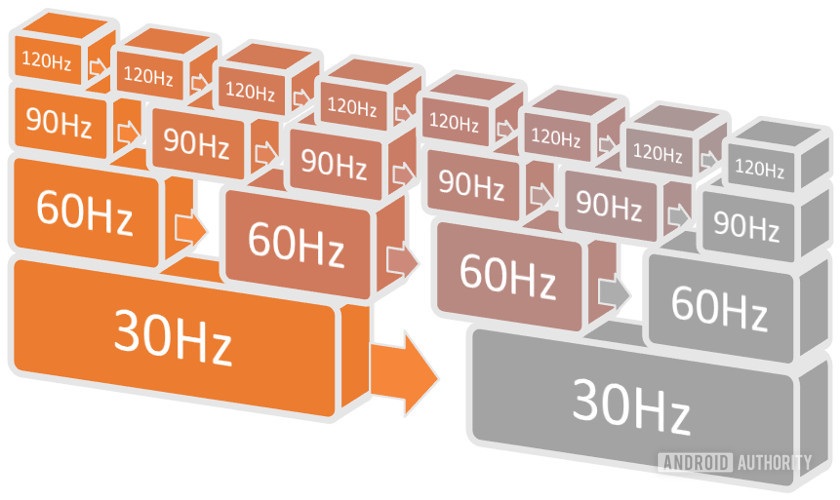
Refresh fee defined: What does 60Hz, 90Hz, or 120Hz imply?
With this in mind, particular person display fashions from totally different producers all look quite totally different, despite the fact that they could have the same refresh price. For example, cheaper shows usually tend to have noticeable issues and poor shade calibration. Be cautious of reasonably priced telephones boasting excessive refresh fee panels as they could possibly be trying to distract from other issues. On the flip aspect, flagship tier telephone displays can go above and past the manufacturing unit colour calibration, as OnePlus showcased with the 8 Professional. That is why it’s still value taking note of traditional display high quality metrics and never simply the refresh price.
A flagship 60Hz show can look higher than an affordable 120Hz panel.
Conventional 60Hz shows can nonetheless look better than 120Hz panels, at the least when it comes to colour accuracy. That is especially true when comparing flagship-tier 60Hz panels to cheaper 120Hz shows. General high quality is certainly more necessary than a barely extra fluid feeling consumer interface. Furthermore, simply because a show boasts 90 or 120Hz capabilities doesn’t imply that almost all of the apps and content material truly benefit from it.
Apps, content material, and Android matter

It’s not simply display high quality that varies from system to gadget — the supply of excessive refresh fee content can range too. There’s little level proudly owning a telephone with a 120Hz display if it’s never used in any case, so that is important to dig into.
The frame price of an app or recreation relies upon not simply on the underlying hardware, but in addition the best way that the appliance is coded to render and the best way Android works. Google has published insights into how excessive refresh fee shows work with content on Android. The first level value noting is that body rates are limited by rendering occasions, controlled by the Android Choreographer. 120Hz displays have just 8.3ms in-between frames by which the GPU has to attract the body. Some apps and video games render on the display’s v-sync refresh fee, so they can operate on the full body fee. Nevertheless, others simply take too long to render or have custom rendering pipelines with slower update speeds, in order that they merely can’t hit 120Hz. As an alternative, games might persist with 90, 60, 45, or even 30fps.
Android 11 improves dealing with of combined refresh fee content, offering apps make use of the new API.
The important thing takeaway right here is that simply because a telephone has a 120Hz show that doesn’t truly imply all apps run at 120Hz. Phones with more processing energy are more likely to hit excessive frame fee targets with lower latency, although some apps might even be optimized for specific platforms.
The state of affairs is further difficult through the use of a number of apps and UI parts directly. Google notes that 120Hz shows are good for viewing 24, 30, 45, and 60fps content material without judder, as these charges as simply divisible by 120. Enjoying again a 24fps video on a 120Hz display avoids the 3:2 pulldown algorithm required by a 60Hz show, for instance. Nevertheless, conflicts can happen between software, resembling a low frame price video and excessive body price UI. At which point Android has to step in and decide a frame price, which may end up in judder and/or a fallback to the standard 60Hz.
 Loading poll
There’s a brand new setFrameRate API in Android 11 that helps to seek out the optimal body price for a number of apps operating directly. Nevertheless, current units need to make do with a choice setting that may result in conflicts. Finally, purposes and video games can influence the refresh price however the last determination is made by the platform. Anticipate next yr’s Android 11 phones to deal with combined refresh price content material better than current fashions.
General, hitting very excessive frame rates for every app is very unlikely. As an alternative, Android dynamically switches frames rates to greatest match the app you’re at present utilizing. However even this will likely depend upon the producer’s implementation.
Display processors are a differentiator

If that wasn’t convoluted sufficient, units also can add in their own display processing layer to upscale or remove judder outdoors of the standard Android framework. Processing energy is essential here, as some results might be energy-intensive. Dedicated display processors (DPU) can run these tasks extra effectively. That’s right, yet another processor inside your smartphone!
Qualcomm’s Snapdragon processors embrace display and visible processors as a part of its Adreno GPU pipeline. These deal with video decoding in addition to graphics rendering, and the appliance processor also can run further show processing software program. For instance, Pixelworks, a company specializing in display enhancement know-how, leverages the Snapdragon 865 to run its Mushy Iris calibration and features like tone-mapping and SDR to HDR on the OnePlus 8 collection. Different SoCs have their very own show processing models as properly, however mid-range and lower-end chips don’t have the hardware to run higher-end features efficiently. For example, the Snapdragon 765G solely helps 120Hz up to FHD+, while the 865 can manage 144Hz at QHD+ resolutions.
Display processors power higher-end features with improved power effectivity.
Complicated show options run more efficiently on devoted processors. These embrace Pixelworks’ Iris5 and Arm’s Mali-D77 or D71, although these supply totally different capabilities. The Iris 5, for instance, is capable of MEMC video body fee upscaling and judder removing. Upscaling and interpolating video, video games, and different apps may help enhance smoothness even if the app runs at decrease frame charges natively. Advanced display processors not only convey new options but can improve power consumption too, an important consideration with power-hungry 120Hz displays.
Additional features and processing options may help elevate a regular excessive refresh fee show to a extra consistent, clean experience. The inclusion of high-end show processors can even help with energy consumption, allowing you to maintain the 120Hz mode on all the time. It’s a hidden distinction, but an necessary one.
Not all 120Hz displays are equal

High frame fee displays are definitely good to have, however there’s rather more to general display quality than simply the hertz. Normal display high quality metrics still apply and a 90 or 120Hz label doesn’t routinely mean great colors or gamma. That stated, 120Hz panels can definitely look wonderful, especially if the telephone has the software and processing energy for enhanced calibration and tone mapping features.
It’s additionally value researching what, if any, high refresh price and other show options ship with a tool. A dedicated processor powering enhanced options could be the distinction between smoother content material and all-day battery life, and a sub-par 120Hz expertise. Not forgetting that newer apps and Android 11 will assist improve the vary of situations where high refresh rates are enabled.
And that’s why not all 120Hz smartphones are the identical.
More posts about shows


Delta City | Tech News
Get Bitcoin just for watching YouTube | http://getbitcoin.gq/
No comments: